
Despite having a reputation for dark stories about physical violence and psychological trauma (which kind of just… happened), I have a soft spot for Christmas. In fact, my very first published work was a Christmas story, and I’ve written several others over the years. So for those looking for something lighter for the holiday season (which is almost over, I know), here are the stories I’ve published over the past 13 years:
 The very first story of mine that was accepted for publication was The Christmas Wager (2010), a Christmas “Regency” (though I set it in the Victorian Era) modeled after similar straight romances stories I’d read from other publishers. It was intended to be light and fun, though reality intervened somewhat – it was impossible for gay men to have an open relationship during that time period, so the fear of discovery had to play a part. But the stories I’d read weren’t terribly well researched, so I assumed nobody would care if mine was sloppy with historical details. I was wrong. The story did well, but readers – especially those in the UK – were put off by the historical and cultural issues. So much so, that I felt compelled to go back and correct them, as much as possible, with the aid of some editors from England. Which is why the novel now has a second edition. It’s now a work I’m very proud of.
My next holiday story (technically, a Yule story, rather than Christmas) was written and submitted later than The Christmas Wager, but it was published first, as part of Dreampsinner’s 2010 Advent Calendar anthology. It was a story about two Icelanders in the Viking Age. One had killed the other’s brother in a feud and the other had attempted to get vengeance, only to be cut down, as well. When he wakes, he discovers he’s being nursed back to health by his enemy. But he soon discovers that this man has grown to hate the feud that wiped out both of their families, and is actually very kind. Can our hero put aside his duty to avenge his brother and pursue peace?
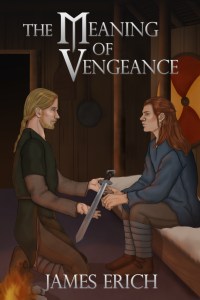 The Meaning of Vengeance was an odd fit for the Advent anthology, in particular because the dark tone of the story didn’t match up with reader expectations, when they bought an anthology with a cute cover of two men decorating a tree in their underwear. I’d also felt, when I wrote it, that it had to have explicit sex in order to sell, but the scenes never really felt right. If anything, the story had a YA feel (both young men were in their teens). So I ended up pulling it from Dreamspinner, reworking it as a YA story, contracting Catherine Dair to do a new cover for it. Unfortunately, it isn’t yet available, because I’m still reworking the pacing. But I’ll have it out next year, under my YA pseudonym, James Erich.
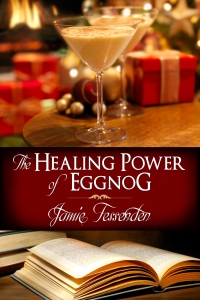 The Healing Power of Eggnog was inspired by the visits I used to take to visit my first boyfriend at Goddard College. Montpelier and Plainfield are real places in northern Vermont and the Christmas tree farm is based upon the many such farms in New Hampshire.
This story was written back when I believed readers wanted “Hallmark Christmas movie” endings, which have the leads fall in love in a very short time. That turned out to not be the case, as two people falling in love over a few days’ time was one of the main criticisms of the story. I’ve been poking at it for a rewrite, but that’s for the future. I do think it’s a nice story, as is—it makes me cry, every time—but the timing needs a little work.
 Though not my first foray into self-publishing, a beautiful cover by Reese Dante and professional editing by Theo Fenraven truly made A Cop for Christmas stand out.
This one is close to home—literally. It takes place in the White Mountains of New Hampshire, near Gorham, where I grew up. Crystal is a tiny town my father once owned a house in. I remember it as about 5 houses clustered around a tremendous waterfall. Fortunately, one of the houses had two girls around the ages of my brother and I, so we had incredible (and somewhat dangerous) adventures together, exploring the river and the forest surrounding it. But I digress…
A Cop for Christmas actually began as a short story idea I had in my 20s. In the original, a cop pulls a guy over and tickets him for speeding and it turns out the cop and the guy’s parents are next door neighbors and friends. My writing chops weren’t up to the task back then, but I always thought it would make a good starting premise. Et voila!
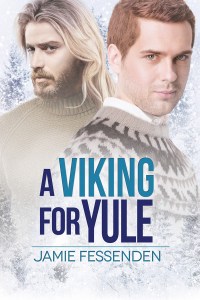 The character of Sam in A Cop for Christmas cried out for a story of his own. Sure, he was a bit pathetic and not strikingly handsome, but after we left him in the hands of Jackie (aka “Auntie Mame“), he traveled the world and grew up. He still had panic attacks during snow storms, but otherwise, he was standing on his own two feet.
Until Jackie decides they should spend Christmas in the snowiest place on Earth (or nearly): Iceland. Worse, she skips off, leaving him in the hands of Arnar, a local “nephew” of hers, to go on a tour of the countryside.
If I had to choose a favorite book of mine, I’d pick this one. I spent months wrapped up in information about Iceland, chatting with friends who lived there, eating food I had shipped, and wandering around Reykjavik and the Icelandic countryside via Google Streetview. By the time the novel was finished, I was exhausted, but I had a very hard time saying goodbye to my virtual vacation in Iceland. I honestly had felt as if I was there. I only hope I get the chance to visit in person someday. It’s a beautiful country.
 During my research for A Viking for Yule, I came across the Nordic spirit or being called “Tomte.” (Pronounced “TOM-teh.”) The name is specifically Swedish—it’s known by different names in different Scandinavian countries, such as the “Nisse” (NIH-seh) or the “Tomtenisse.” It resembles a little old man dressed in red clothes with a pointy hat and pointy boots (which is basically peasant clothing from the middle ages). The tradition that specifically interested me was one in which the
Tomte is believed to be the spirit of a human who’d lived (and died) on a farm a very long time ago, guarding over his descendants. Combine that with folktales of people stumbling into the land of the fae for a night, only to return to discover several years have passed in the human world. (No, this idea did not originate with Rip Van Winkle. Irving took it from European folklore.)
So this was the seed from which my novel Tomte grew. It was also my first attempt at Urban Fantasy—inserting fantastic elements into a realistic, contemporary setting and slipping them in casually, so the reader has to pause for a moment to figure out if it’s real or not. (That’s my definition, anyway.) I’m proud of the result, and hope to write more like this in the future!
Lastly, I’ll add in the fun “Twelve Days of Stories” that Wrote Podcast did in 2015. The idea was to assign each writer one of the 12 days of Christmas from the song and see what they could come up with in a very short period of time. My story was based upon 5 rings, and I decided to place my story on a space station orbiting Saturn. The rings begin with a ring on the coffee table in the café our main character works in and expands to the rings of Saturn and the space station (which has artificial gravity induced by centrifugal force). It’s short and I’d love to expand it someday, but you can listen to the current version here for free!

 The Christmas season in Iceland is still called Jól—Yule—as it was before the country was Christianized, and many of the popular traditions still have a very pagan feel to them. At this time of year, the sun doesn’t rise until nearly 11:30 a.m. and sets around 3:00 p.m. The shortest day (the winter solstice, December 21st) is just four hours long. So most of the day is dark. But the largest city in Iceland, Reykjavik, is lit up like a Christmas tree!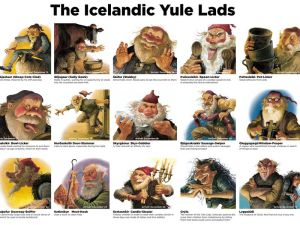

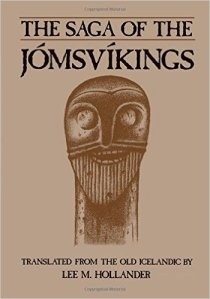 I’ve been working on a novel for a while now—an adaptation of The Saga of the Jomsvikings, which was written in Old Icelandic in the 13th century. It tells of an elite band of viking warriors residing in the fortress of Jomsborg on the island of Jom. They were theoretically real, though it’s hard to say how much truth there is to the story. They appear in other sagas, including the ones I based my first YA novel Seidman on. But by then, they were in decline. They appear briefly at the battle of Svoldr, when King Olaf Tryggvason was defeated, but they quickly decided to sit the battle out.
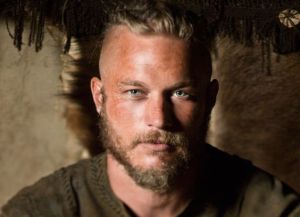 Bragi is older than most of the men in the fortress, and he’s seen a lot of combat. He’s weary of the death he sees on the battlefield, but he’s a survivor and he takes pride in his skill with a blade. At Jomsborg, he’s given the opportunity to pass some of his knowledge of fighting techniques along to others and help keep them alive. The actor who most closely resembles him is Travis Fimmel from Vikings.
 Asleif is young, and he has endured a lot of teasing over the years because of his feminine features, even after he grew to stand over his comrades. He’s skilled and cocky, and sees Bragi as a challenge. But he also senses a strong sexual undercurrent between them. Bragi is hesitant to pursue it, but Asleif gleefully chases after him, despite the danger of discovery. I found this picture online, which I believe is of Alexander Skarsgard, and despite the modern clothes and background, it perfectly represents the image I have of Asleif in my head.
 Things have been pretty quiet on both my adult blog (
 Moving forward, I’m currently working on a novella about alien abduction for the next Gothika anthology (see previous installments:
  In the meantime, I have the re-release of my first novel,












 Jamie Fessenden's Blog